I. Industry Pain Points: Traditional Barcode & Manual Management Fail to Meet the Demands of Million-Scale Biobanks
With the continuous expansion of biobanks in medical institutions, laboratories and research institutes, cryopreserved biological samples ranging from tens of thousands to millions are trapped in multiple management dilemmas, and the drawbacks of traditional modes have become prominent:
1
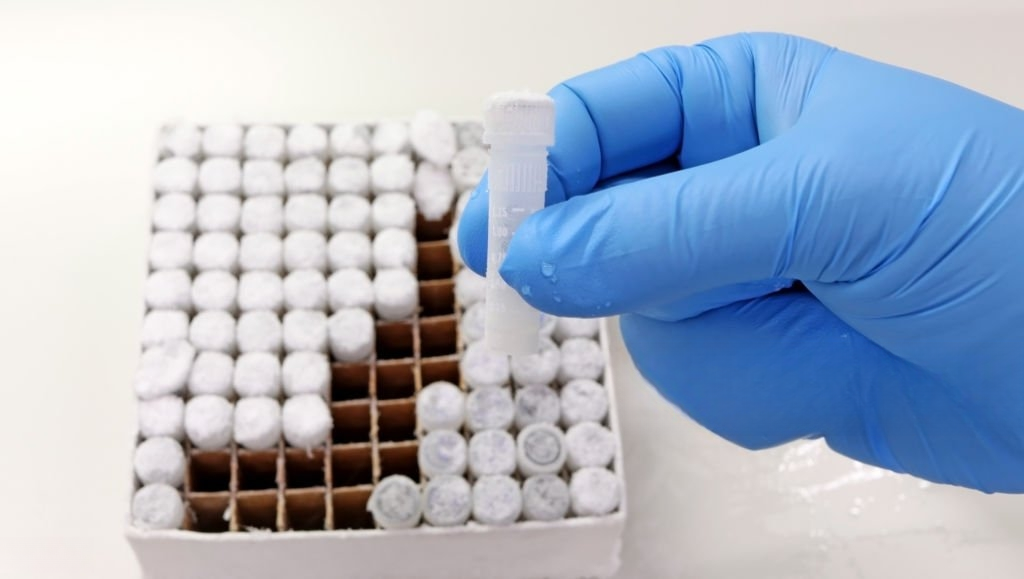
Frost formation at low temperatures renders barcode recognition completely invalid After cryovials are taken out from liquid nitrogen tanks or -80°C freezers, frost rapidly forms on tube walls. 1D/2D barcodes rely on visual scanning, and heavy white mist will block labels and make scanning impossible. Repeated thawing and wiping for scanning will damage sample activity, while manual counting of one box of samples takes dozens of minutes with extremely low inventory efficiency.
2
Error-prone manual registration leads to high costs of misplacement and loss of samples The whole process depends on handwritten ledgers and manual data entry. Blurred serial numbers, label falling off and mixed samples occur frequently. Once precious tissue and cell samples are confused, experiments will be scrapped and clinical data invalidated, causing immeasurable losses to scientific research and medical treatment.
3
Difficult batch inventory and inability to accurately locate single tubes Traditional management can only distinguish storage areas instead of specific positions inside cryoboxes. Staff have to rummage through boxes to find target samples, which triggers frequent temperature fluctuations of low-temperature equipment and impairs sample activity. Mass sample warehousing, outgoing and inventory rely entirely on manual labor, resulting in high manpower costs.
4
Ordinary labels are prone to damage under sterilization and ultra-low temperature conditions Samples require gamma-ray irradiation sterilization and long-term immersion in liquid nitrogen at -196°C. Paper stickers and ordinary electronic labels will crack and lose signals under such harsh medical environments. Meanwhile, unencrypted data can be altered arbitrarily, failing to meet the traceability compliance requirements of GLP and GMP standards.
5
Isolated data and lack of full-life-cycle traceability capability Barcodes have limited storage capacity and cannot record segmented information of sample collection, cryopreservation, access and destruction. Without unique identity codes, circulation records are fragmented, and complete and reliable electronic vouchers are unavailable for audit and inspection.
II. RTEC One-Stop RFID Low-Temperature Sample Solution to Address All Pain Points Targetedly
Based on self-developed ultra-small RFID cryovial tags resistant to deep low temperature & liquid nitrogen, plus intelligent inventory reading & writing equipment, we provide an integrated solution consisting of RFID cryovial tags, RB series reading & writing terminals and intelligent management platforms, covering all scenarios including hospital clinical laboratories, biobanks and various scientific research laboratories.
(I) Core Hardware 1: RTEC E-S (D4.8) Ultra-Small RFID Cryovial Tag
Customized through integrated injection molding for liquid nitrogen cryovials, fundamentally solving the problem of low-temperature identification failure
1
Extreme resistance to ultra-low temperatures Encapsulated with industrial-grade FR4 resin, stably resistant to liquid nitrogen at -196°C and repeated freeze-thaw shocks. Frost and condensation will not interfere with radio frequency reading. Compatible with medical gamma-ray irradiation sterilization with no performance degradation after sterilization.
2
Miniature integrated design Fits standard cryovials with an ultra-thin size of Φ4.8mm (customizable down to 3mm). It is embedded into the bottom of cryovials via integrated injection molding, weighing only 0.1g without occupying sample storage space, eliminating risks of falling off and damage.
3
Large-capacity encrypted storage with globally unique traceable ID Compliant with EPC Global Class 1 Gen2 / ISO18000-6C universal protocols, equipped with Kiloway KX2005XBR chip. It features non-tamperable 128-bit EPC and globally unique TID codes, plus a 1312-bit large-capacity user area supporting segmented and batch writing of multi-dimensional sample information to realize closed-loop traceability of the full sample life cycle.
4
Stable radio frequency reading, optimal performance in non-metallic environments Adopts UHF 902-928MHz standard frequency band with a reading distance of 0.5m in non-metallic environments. Alignment and defrosting are unnecessary; disordered batch reading enables instant identification of all samples in one box.
(II) Core Hardware 2: RTEC RB Series Intelligent Inventory & Positioning Reader (RB-0909/RB-1010)
Specialized intelligent inventory equipment for biobanks to achieve precise positioning of single cryovials
1
Ultra-fast full-box batch inventory and accurate positioning of individual tubes Perfectly compatible with standard SBS cryoboxes of 9×9 and 10×10 specifications (custom special sizes available). No defrosting waiting is needed after taking samples out of liquid nitrogen; the equipment can finish inventory quickly once the box is placed inside. The system automatically locks the precise position (row & column coordinates) of each sample tube, eliminating manual rummaging.
2
Robust industrial-grade stable performance Equipped with RK3568 2.0GHz main control chip, 4GB RAM + 32GB storage and a 15.6-inch capacitive touch screen. Dual communication modes of RJ45 Ethernet and WiFi support offline inventory; data is cached locally when disconnected from the network and automatically synchronized after reconnection. It operates stably under temperatures ranging from -30°C to +65°C and relative humidity of 5%–95% without condensation.
3
Simplified development and seamless docking with laboratory systems Standardized UHF RFID protocols and simple control commands enable convenient development and deployment. It can connect with LIS and biobank management systems to automatically update records of sample warehousing, relocation and outgoing, with full data automatically retained.
(III) Supporting Intelligent Management System: Digital Control Hub for Samples
One-click batch inventory Complete counting of tens of thousands of samples within minutes, automatically compare ledgers and quickly mark missing and misplaced samples;
Precise positioning & retrieval Input sample number to display the exact location including cryogenic tank, cryobox and row & column coordinates;
Full-process traceability & data storage Automatically record all links including collection, cryopreservation, access, transfer and destruction. Encrypted non-tamperable data generates complete electronic files for compliance audit;
Hierarchical permission control Separate permissions for operators and administrators, with full retention of operation logs to avoid unauthorized sample access risks.
III. Core Advantages of the Solution: Reshape Biobank Management Modes
1
100% recognition rate regardless of low-temperature frost Breaking the visual scanning limitation of barcodes, radio frequency signals penetrate frost and mist for wireless reading. Repeated thawing and wiping are avoided to maximally protect the biological activity of precious samples.
2
Millimeter-level precise positioning drastically cuts sample searching time Shift from "searching one box" to "searching one tube", eliminating massive manual rummaging and reducing energy consumption and sample damage caused by frequent opening and closing of low-temperature freezers.
3
Contactless batch reading boosts inventory efficiency by over 90% Manual counting of one box takes dozens of minutes, while the RFID solution finishes full-box identification in seconds, greatly reducing daily inventory workload for million-scale biobanks.
4
Medical-grade durability compatible with sterilization and long-term liquid nitrogen storage Special low-temperature resistant packaging resists gamma rays and ultra-low temperatures without damage after long-term liquid nitrogen immersion. The tags can be recycled with cryovials to cut long-term consumable costs.
5
Compliant traceability meeting medical and scientific research supervision standards Globally unique non-tamperable TID codes and auto-generated complete electronic ledgers facilitate smooth inspections by drug regulatory authorities and scientific research project audits.
6
Lightweight software-hardware integrated implementation Small-sized hardware for easy installation; software compatible with existing laboratory information systems with short deployment cycles, suitable for new biobank construction and renovation of outdated facilities.
IV. Applicable Scenarios
Biobanks, clinical laboratories and pathology departments of all levels of hospitals; universities, pharmaceutical enterprises and third-party testing laboratories; scientific research institutes engaged in life science, gene and stem cell research; various ultra-low temperature liquid nitrogen sample storage centers.
Conclusion
Biological samples are non-renewable core resources for medical treatment and scientific research. The traditional manual + barcode management mode can no longer adapt to the digital upgrading of large-scale biobanks. RTEC’s self-developed low-temperature RFID cryovial tags and dedicated intelligent inventory equipment provide a one-stop solution to four core pain points: unreadable labels under low temperature, low inventory efficiency, vague positioning and insufficient traceability. With micro cold-resistant radio frequency technology, we build a safe, efficient and traceable modern intelligent sample management system, facilitating the standardized and intelligent transformation of China’s biological sample industry.